
Summary: This article explains what shapes your Teams structure and gives you a starting point for Retail, Consumer Goods, and Sports & Entertainment accounts.
There's no single correct way to set up your teams. The right structure reflects how your business actually runs its social marketing, customer care, and social commerce work — not a generic template.
What a team defines
Each team you create ties together three things:
-
Resources your team members can use — profiles, ad accounts, and collections
-
Modules and workflows they can access — Publisher, Community, Care, Unified Analytics, and approval flows
-
People they collaborate with
A member's team role then sets exactly what they can do with those resources.

Six factors that shape your structure
Before you decide on a structure, consider these six factors. They apply regardless of your industry:
-
Number of brands. If you manage a single brand, brand probably won't be a team boundary. If you manage a portfolio of brands, separating them into different teams protects their competitive and creative independence.
-
Number of regions or markets. If you operate in several markets with different languages, compliance needs, or local execution, region often becomes a team boundary — either on its own or nested under brand.
-
Departments or functions. If you run Marketing, Care, and Commerce as genuinely separate functions, department can become its own boundary, layered on top of brand or region. For example, you might run one shared Care team across all your brands, or a separate Care team per brand or market.
-
Centralized or decentralized operations. If your organization runs day-to-day work centrally, you'll typically need fewer teams, with permissions managed through shared role templates. If local or departmental units operate with real autonomy, plan for more teams, each with its own team admin.
-
Agencies, distributors, and other external partners. If an outside party — an agency, a distributor, a licensee — manages resources on your behalf, give that relationship its own team, typically under Restrictive mode. A separate team isn't the only option, though: where an agency works closely with a specific market or brand's own members, add its staff directly to that team instead, with an appropriate role — closer collaboration can matter more than isolation.
-
Multi-step workflows and role hierarchies. If work moves through tiers — frontline replies versus oversight in Care, content that needs approval before publishing, cases that escalate from Community to Care — plan for more than one role per team.
These factors usually combine rather than act alone. For example, if you run multiple brands across multiple markets, your core team is often the combination of the two — a regional brand, such as "Brand A — Czech Republic" — rather than the brand or the region alone. If a function like Care also needs its own boundary, that becomes a further layer, such as "Brand A — Czech Republic — Care."
Note: Collaborative and Restrictive mode never change which resources a team can access — that's always controlled by team assignment. The mode only controls whether people in different teams can see or collaborate with each other. Choose Restrictive if you have multiple brands or external parties that need to stay separate from each other; choose Collaborative if you have a single brand with no external parties and want cross-team coordination. See Govern Access to Account Resources Using Teams for details on both modes.
Retail
Retail accounts range from single global chains to multi-banner portfolios. Two things typically define your structure regardless of banner count: a high number of markets, since Care and Community work usually needs to happen locally, and a high volume of Care and Community activity from customers asking about orders, promotions, and in-store issues.
Typical structure
-
If you run a single banner across multiple markets, use region or market as your core team unit, each with its own profiles and Care/Community roles.
-
If you run multiple banners, use brand as your primary boundary, with region as a secondary layer inside each brand.
-
Separate frontline Care replies from oversight and configuration by using a Care agent role for frontline work. That oversight layer doesn't have to be a per-team Team Admin — HQ may prefer to hold it centrally itself, especially in a single-brand, Collaborative-mode account, rather than delegate a Team Admin to every market.
-
For a single-brand retailer, build roles from shared templates rather than one-off per-market roles, since expectations tend to be mirrored across regions and departments.
-
If you work with both markets you own and markets run through distributors, structure them as two separate ownership tiers rather than treating every market the same way.
-
If you need to benchmark a profile's performance against another's, add the other competitive profile to the requesting team as a public resource, without granting an owned connection. This gives read-only visibility into that profile's public content and metrics, without exposing private management.
Example
A single-banner retailer operating across dozens of markets might run one team per market, split into two ownership tiers — markets it owns directly, and markets run through local distributors. Roles are typically created from shared templates, since expectations are largely the same across regions and departments in a single-brand retailer, and the account runs in Collaborative mode to support full collaboration between departments and regions. A dedicated team admin per market isn't always necessary — HQ often prefers to centralize that administrative work itself rather than delegate it locally.
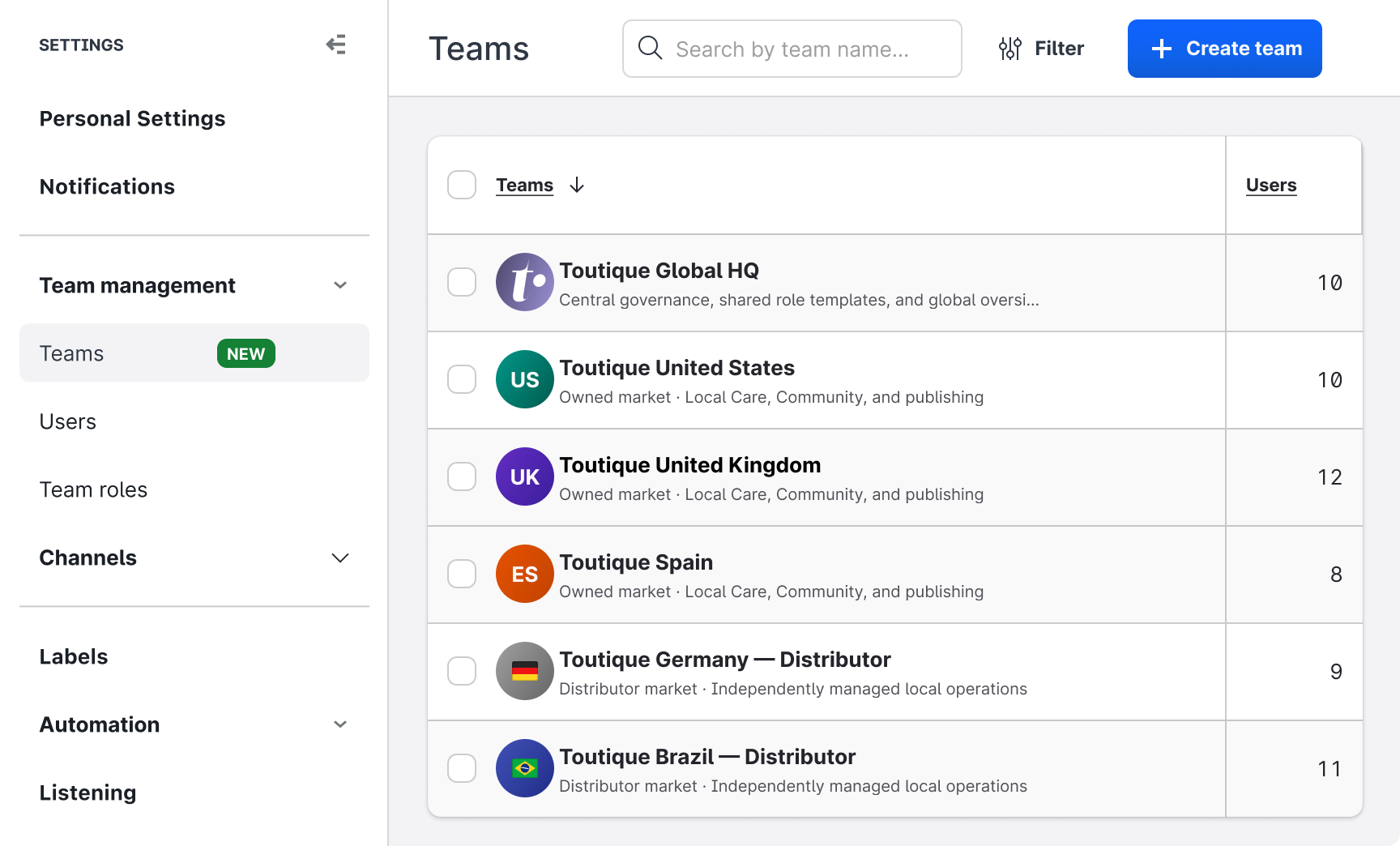
.png?cb=26eb39a23fdc7d77469c4413503c4436)
Common mistakes to avoid
-
Skipping a content-approval step before publishing, when local advertising and consumer-protection rules vary by country.
-
Using one global team for a multi-market account, which forces local staff into a language and context that doesn't match their market.
-
Using one flat Care role instead of separating frontline replies from oversight, which removes any review step before public replies go out.
-
Leaving a multi-banner account in Collaborative mode by default, which lets competing banners' staff interact directly even though their resources stay separate.
-
Treating distributor markets like owned markets, when the ownership difference should drive both separation and autonomy — a distributor is a separate legal entity, not your own staff, and distributors (like most agencies) need to work independently, with their own team admin, unless an agency is embedded closely enough with a market's own staff.
Consumer Goods (FMCG / CPG / OTC)
Consumer Goods accounts are portfolio-first: one organization manages many largely independent brands, each close to a standalone business. Regulatory scrutiny tends to run higher than in most industries, especially for OTC and food and beverage brands, where health or nutrition claims need legal sign-off before publishing.
Typical structure
Which layer comes first depends on how your organization's functions grew:
-
If Care-type work and Marketing-type work evolved as separate operations, use department as your primary layer and region as a secondary layer underneath it.
-
If portfolio-brand independence is your dominant driver instead, use brand as your primary layer and region as secondary.
These two patterns can coexist — an autonomous sub-brand can repeat the same department-then-region structure on its own.
-
Give complex Care escalations a dedicated risk or escalation team, rather than folding them into each region's day-to-day team.
-
Build roles from shared templates by default, since expectations tend to mirror across regions and brands — reserve a dedicated team admin for regions or brands that run on an independent contract or operate as their own sub-brand.
-
Run the account in Restrictive mode overall, with collaboration links set up between teams that need to work together — Community escalating to Care, or a cross-region campaign — rather than opening full collaboration account-wide.
-
Use one team per external-party pairing (agencies, distributors), Restrictive mode by default.
-
Add a distinct approver role above the content-creator role for OTC or food and beverage brands with regulated claims.
-
If you need to benchmark a profile's performance against another's, add the other competitive profile to the requesting team as a public resource, without granting an owned connection. This gives read-only visibility into that profile's public content and metrics, without exposing private management.
Example
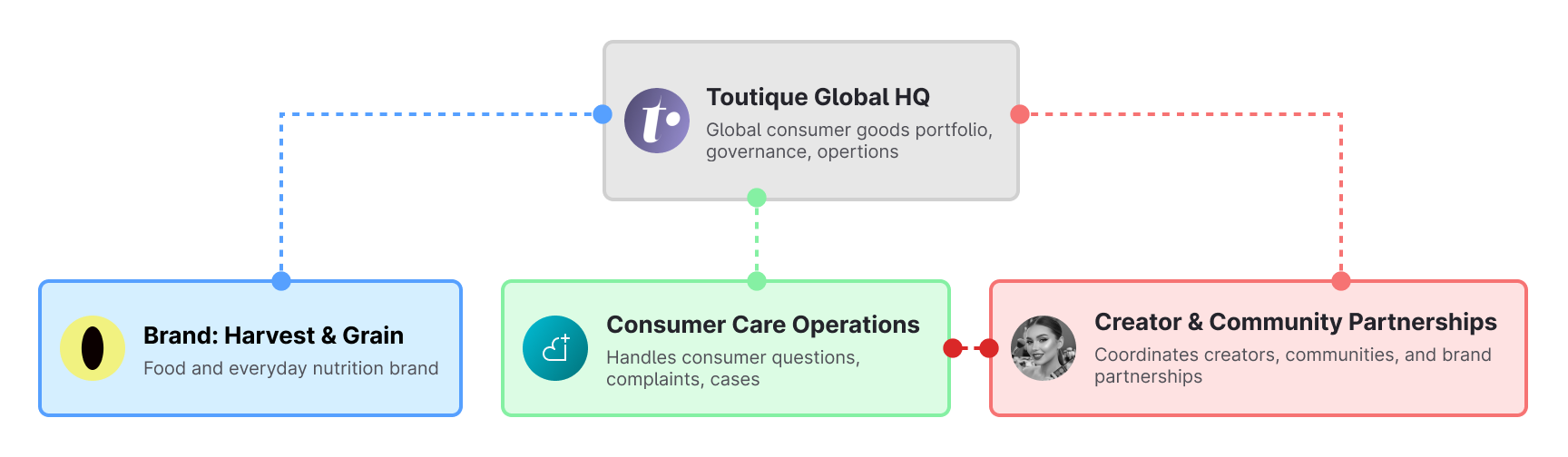
A multi-brand consumer goods company might run Care-type work and Marketing-type work as separate departments, each split into several regional teams underneath it. Roles are typically created from shared templates for most of those regions, since expectations are largely mirrored across regions and brands; a region or brand built on an independent contract, or representing a separate sub-brand, has its own team admin instead. The account runs in Restrictive mode, with collaboration links set up between teams that need to work together — for example, Community escalating to Care, or a cross-region campaign.
.png?cb=725bf327e95f94c878af7ba35d64a0c2)
Common mistakes to avoid
-
Assuming a brand-first structure applies to every account, when the real driver may be how your departments historically grew rather than brand independence.
-
Treating the approval role as optional or interchangeable with a marketing-lead role — health, nutrition, and safety claims are usually regulated per market, so OTC and food and beverage brands need it to be distinct and accountable.
-
Folding complex-case escalation into each region's day-to-day team instead of giving it a dedicated team.
-
Sharing one team across two brands that should stay walled off — for confidentiality, agency-conflict reasons, or competitive separation between sibling brands.
-
Expecting Teams governance to extend past the platform boundary: once a Care escalation hands off to a service function outside the platform, that's a handoff point your team structure can't close.
Sports & Entertainment
This industry is defined by many semi-independent properties under one umbrella — individual teams or franchises in a league, or individual titles and releases for a studio. Each property usually runs its own day-to-day social voice. Activity is event-driven, which creates sharp content spikes, and reputational risk from sponsorship or talent-related content tends to run higher than in other industries.
Typical structure
-
Use the property — the individual team, franchise, or title — as your core team unit, each with its own team admin.
-
Create one HQ team to hold your organization's own official profiles. Platform admins in that team already have visibility into every property team's users and resources by default — you don't need to add them to each property team separately.
-
Use region as a secondary layer only if you distribute globally, such as localizing a release per market.
-
Build roles per team rather than from a shared template — expectations for a team's own roles can vary from property to property.
-
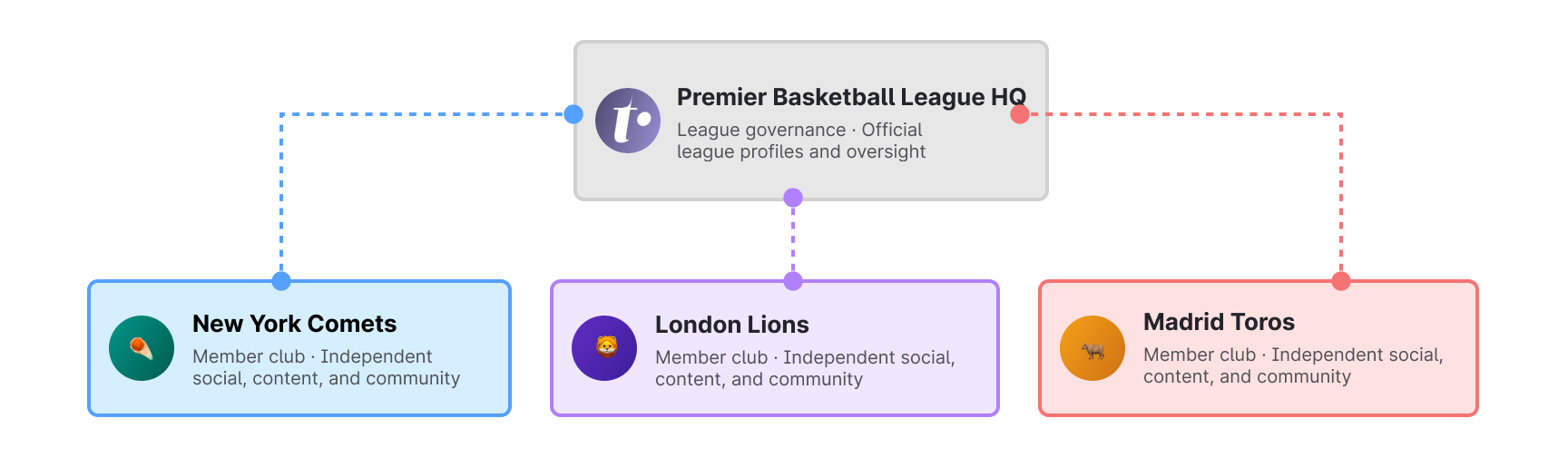
Run the account in Restrictive mode overall, with a collaboration link established between the HQ team and each property team so league staff can work directly with them without opening full account-wide collaboration.
-
Add a clear approval tier for sensitive content — sponsorship mentions, talent-related content, crisis response.
-
If you need to benchmark a profile's performance against another's, add the other competitive profile to the requesting team as a public resource, without granting an owned connection. This gives read-only visibility into that profile's public content and metrics, without exposing private management.
Example
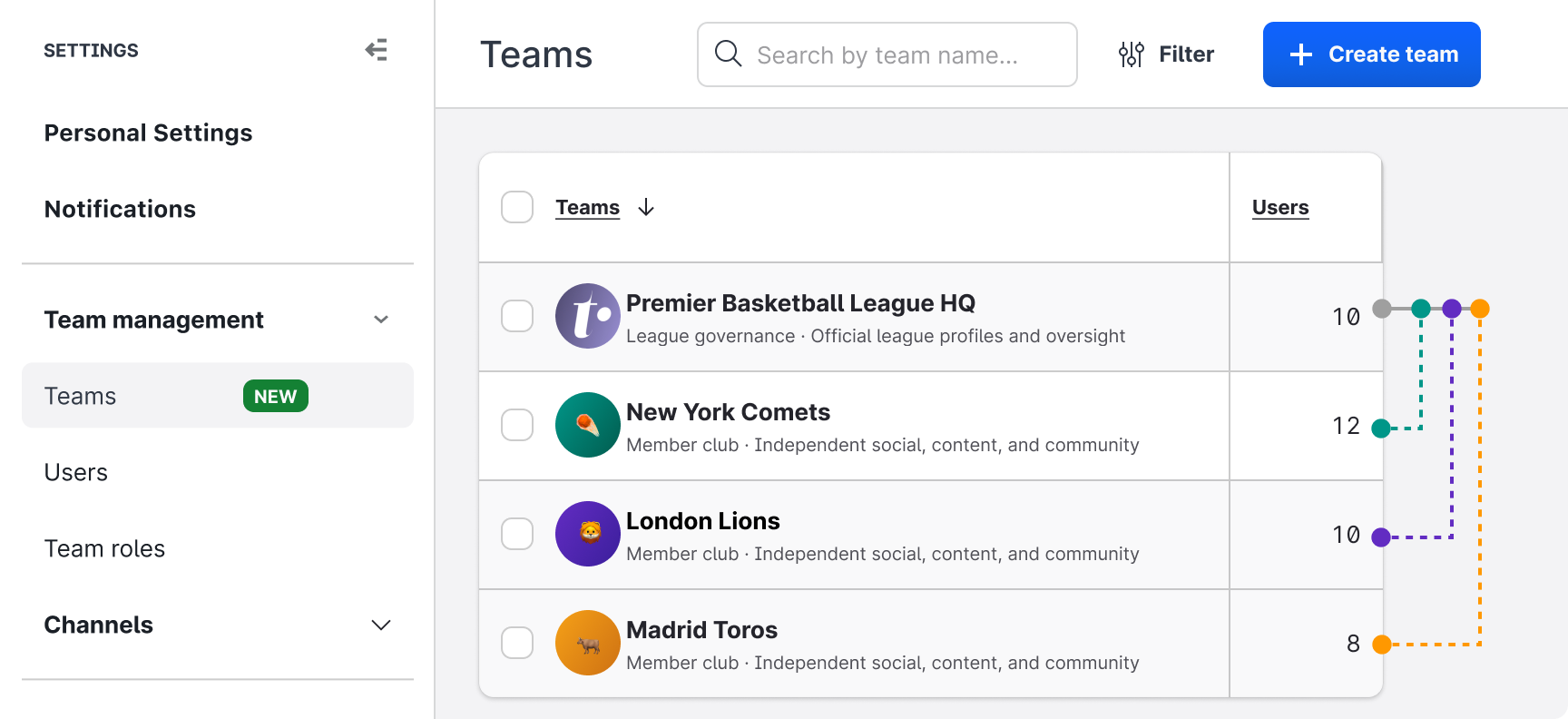
A sports league might run one team per member club, each with its own team admin who can add profiles, assign users, and manage roles within that team. Because expectations for a team's roles can vary from club to club, roles are typically individualized per team rather than built from a shared template. The account runs in Restrictive mode, with a collaboration link established between the HQ team and each club's team so the league can work directly with them when needed.
Common mistakes to avoid
-
Using one shared team across all properties, which erases the distinct voice each one needs.
-
Not isolating properties that compete for the same sponsors or audience, even within the same parent company.
-
Under-provisioning the approval tier for event-driven content spikes — sponsorship and talent-related content carry high reputational risk even without a regulatory requirement, so skipping review during high-risk moments is a real cost.
-
Assuming full isolation between properties is always sufficient, when some organizations need controlled cross-team visibility for benchmarking.
-
Treating properties that involve minors, such as youth leagues or family entertainment, the same as your general approval discussion, instead of flagging them separately.