
How access is governed in your account
Emplifi supports two governance models for user access. Both models use the same underlying granular permissions, but they organize and assign those permissions differently. Knowing which model your account uses helps you find the right setup instructions in our documentation.
-
Teams is the standard governance model and the recommended setup for new and onboarding accounts. Access is organized around teams — groups of users and resources (such as social profiles) with a defined set of products they can access. A user's specific permissions come from their team role. To learn more, see Govern Access to Account Resources Using Teams.
-
Legacy governance model is the original Emplifi access model. Access is controlled through account roles (what a user can do in the platform overall) and profile roles (which profiles a user can interact with, and how). Many existing accounts still use this model. To learn more about account roles, see Account Roles.
Which model does my account use?
Open Settings:
-
If you see Team management in the left sidebar, your account uses Teams.
-
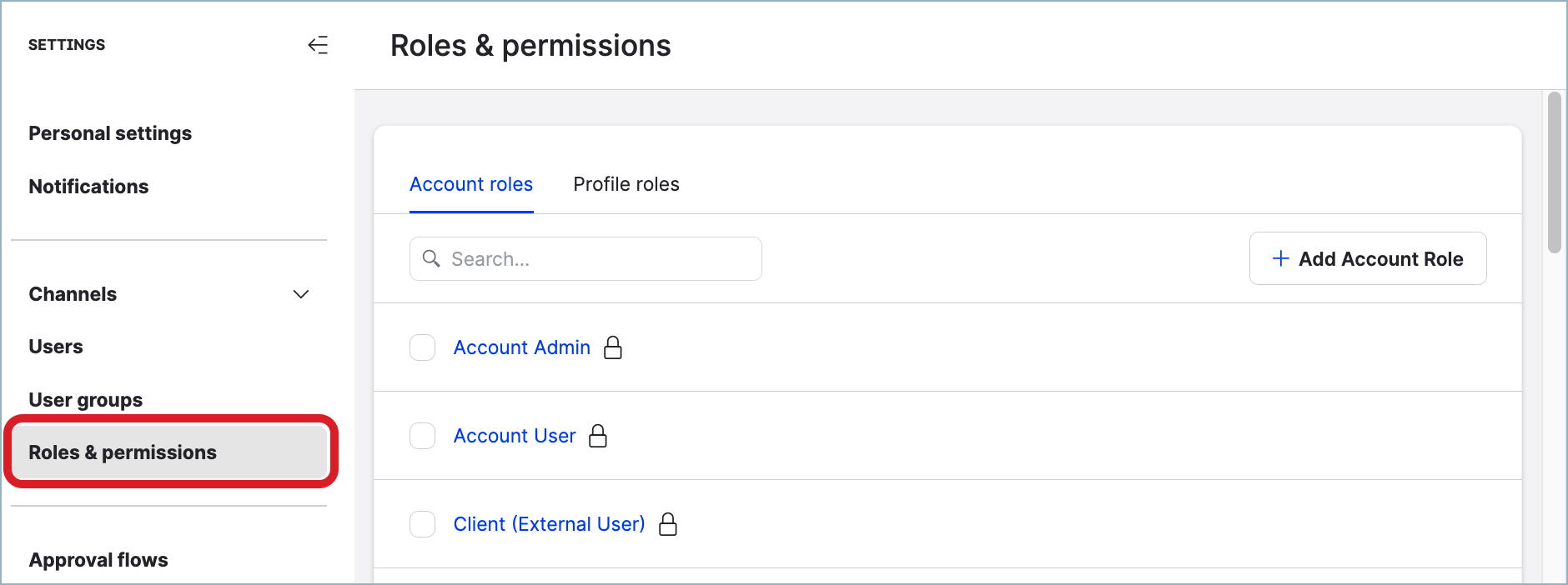
If you see Roles & permissions in the left sidebar, your account uses the legacy governance model.
If you are unsure or want to switch your account to Teams, contact your Customer Success Manager or Emplifi Support.
Setting up user roles and permissions enables smooth and governed usage of the Emplifi platform.
You can select and customize user roles and permissions for secure management and viewability of the modules (such as Dashboard, Unified Analytics, Care, and so on), profiles, and approval workflows.
Where to find user roles
You can access the user roles and permissions in the Settings section of your Emplifi account, under Roles & permissions.
Types of user roles
The Emplifi platform provides the following types of the user roles:
-
Account roles
Account roles control what a user is allowed to do in various modules of the Emplifi platform (such as Publisher, Community, Care, and so on) and whether they can use specific platform functions (for example, manage other users and their user roles, assign labels to content, set up and manage listening queries, and so on).
For more information, see Account Roles. -
Profile roles
Profile roles define what a user is allowed to do with the content of individual profiles in the Emplifi account (view content, create and publish content on social media, delete content, and so on) and whether the user is allowed to communicate with customers on social media on behalf of the profiles (post a public reply or send a direct message).
For more information, see Profile Roles.